Profile:
Atul Bose was one of the most accomplished painters of academic realism in twentieth-century India, renowned for his mastery in portraiture and his significant role in shaping art education in Bengal. Born in 1898 in Bengal, Bose received his early training at the Government School of Art, Calcutta, where he was exposed to both academic and emerging nationalist approaches to art.
Seeking further refinement, Bose travelled to Europe and studied at prestigious institutions including the Royal Academy of Arts, London, and the Académie Julian, Paris. This exposure to European academic traditions—particularly in portraiture, anatomy, and tonal modelling—deeply informed his artistic practice, enabling him to achieve a high degree of technical sophistication.
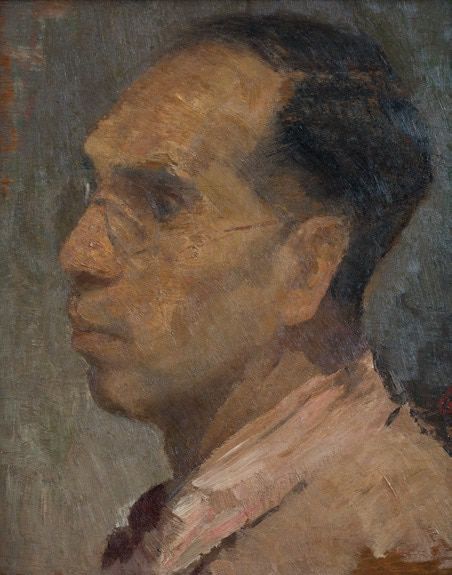
Atul Bose is best known for his formal portraits, which combine psychological insight with meticulous attention to detail. His works demonstrate a remarkable ability to capture likeness, character, and social presence, making him one of the most sought-after portrait painters of his time. His compositions are marked by controlled brushwork, balanced tonality, and a restrained yet expressive palette.
Unlike the more stylised approaches of the Bengal School, Bose remained committed to naturalistic representation, aligning himself with the academic realist tradition. However, his work is not merely imitative of European models; rather, it reflects a synthesis of Western technique and Indian sensibility, particularly in his treatment of subjects drawn from Indian society.
Beyond his individual practice, Bose played a crucial institutional role as an educator. He served as Principal of the Government College of Art & Craft, Kolkata, where he influenced generations of artists and contributed to the development of structured art education in post-independence India.
His works have been exhibited widely and are held in important public and private collections. Over time, his contribution has come to be recognised not only for its technical excellence but also for its role in sustaining and advancing the tradition of academic realism in India.
Atul Bose’s legacy lies in his dual identity as both a master portraitist and an influential educator, whose work continues to serve as a benchmark for realism, discipline, and artistic integrity within the Indian art historical framework.