Profile:
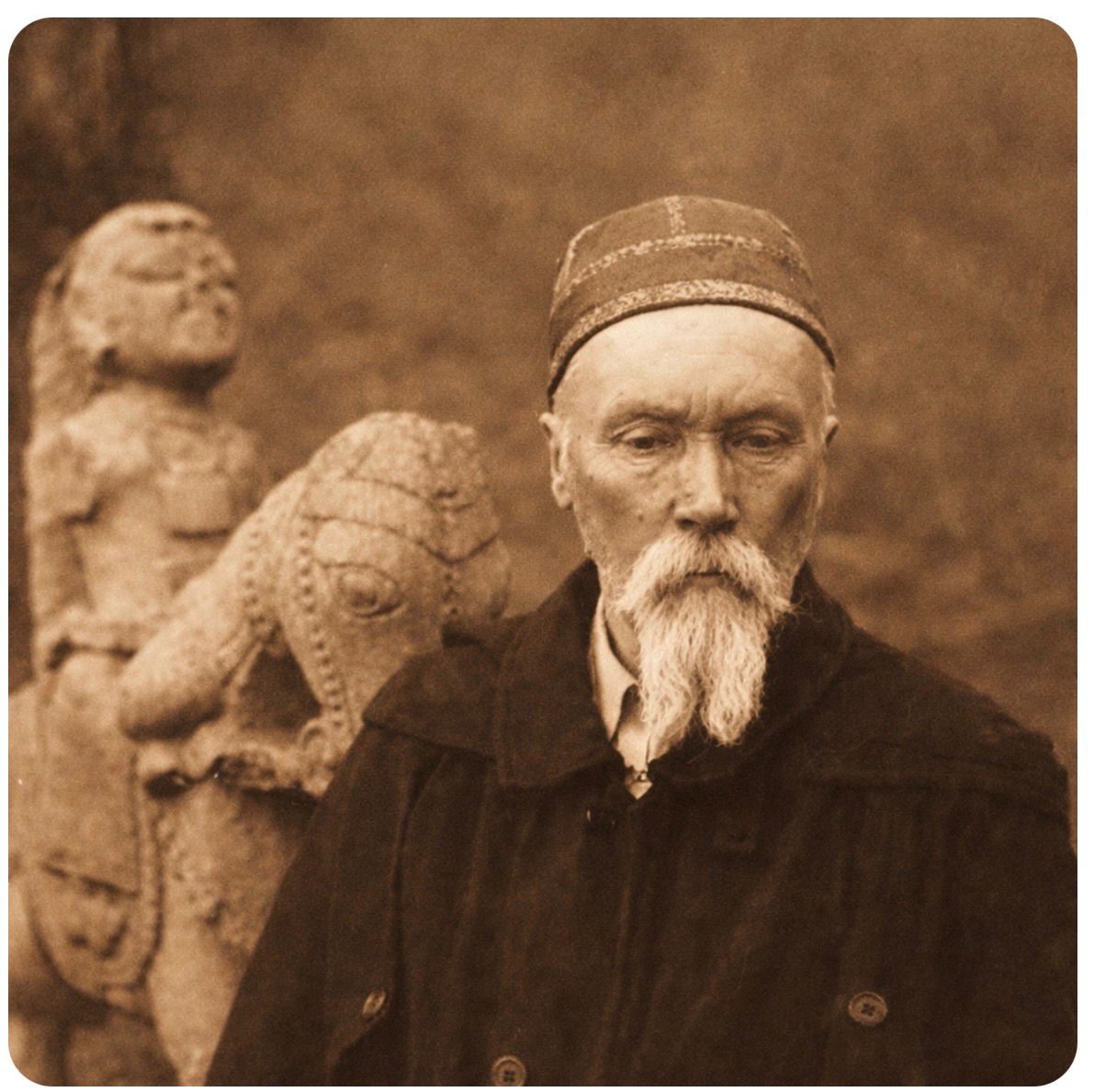
Nicholas Roerich was a Russian-born painter, philosopher, archaeologist, and cultural thinker whose artistic and intellectual legacy occupies a unique position at the intersection of European modernism and Himalayan spirituality. Born in 1874 in St. Petersburg, Russia, Roerich received formal training at the Imperial Academy of Arts and later studied law at the University of St. Petersburg. His early artistic practice was shaped by Russian symbolism, historical themes, and stage design.
Roerich’s life and work underwent a profound transformation following his travels through Central Asia and the Indian subcontinent, culminating in his settlement in Naggar, Kullu Valley (Himachal Pradesh) in the 1920s. It is here that he produced some of his most iconic works, establishing a distinctive visual language centred on the Himalayas—not merely as a geographical landscape, but as a symbolic and spiritual realm.
His paintings are characterised by luminous colour fields, simplified mountain forms, and an almost transcendental treatment of light, evoking a sense of mysticism and cosmic harmony. Works such as the Himalayan Series transform landscape into metaphysical space, where nature becomes a conduit for higher consciousness. Roerich’s approach aligns with broader currents of symbolism and theosophical thought, yet remains deeply personal in its vision.
Beyond painting, Roerich was an active cultural advocate. He initiated the Roerich Pact (1935)—an international treaty for the protection of cultural heritage during armed conflict—underscoring his belief in the preservation of art as a universal human value. He also founded the Roerich Institute of Himalayan Studies (Urusvati), which promoted interdisciplinary research in the sciences and humanities.
Roerich’s works have been exhibited internationally and are held in major collections across Russia, India, Europe, and the United States, including institutions in New Delhi and his estate in Naggar. In India, he is regarded not as an outsider but as an adopted cultural figure whose work resonates deeply with the country’s spiritual and artistic traditions.
Nicholas Roerich’s legacy lies in his ability to merge art, philosophy, and cultural diplomacy, creating a body of work that transcends national boundaries and continues to inspire both artistic and intellectual discourse.